-2022- درس 1 | الروابط الكيميائية | الصف 8 | الفصل 2 | العلوم والحياة
TL;DR
This lesson explains the formation of ionic and covalent chemical bonds, driven by atoms' pursuit of stability, and demonstrates how these bonds are represented using chemical formulas and structures.
Key insights
Understanding Chemical Bonds: The Driving Force for Atomic Stability
- Atoms strive for stability by achieving electron configurations similar to noble gases.
- This stability can be reached by losing, gaining, or sharing electrons.
- Chemical bonds form as a result of these electron interactions.
The Ionic Bond: A Transfer of Electrons Between Metals and Non-metals
- Ionic bonds form between atoms that readily lose electrons (metals) and those that readily gain electrons (non-metals).
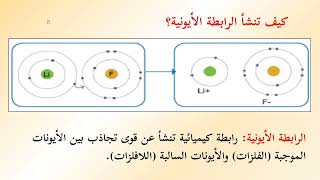
- This transfer results in the formation of oppositely charged ions (cations and anions).
- The electrostatic attraction between these ions creates the ionic bond.
The Covalent Bond: Sharing Electrons for Stability
- Covalent bonds occur between non-metal atoms with similar tendencies to gain electrons.
- Atoms share valence electrons to achieve a stable electron configuration.
- This sharing can involve single, double, or triple bonds depending on the number of shared electron pairs.
Representing Chemical Compounds: Formulas and Structures
- Chemical formulas indicate the type and number of atoms in a compound.
- Structural formulas show the arrangement and bonding of atoms within a molecule.
- Understanding these representations is key to comprehending chemical composition and behavior.
Key moments
- 01:16The lesson aims for students to distinguish between ionic and covalent bonds, introducing the concept of ionic bond formation through an activity involving Lithium and Fluorine.
- 03:47Ionic bonds are formed by the electrostatic attraction between positively charged ions (formed by metals losing electrons) and negatively charged ions (formed by non-metals gaining electrons), leading to stability.
- 04:38An example illustrates the formation of an ionic bond in Magnesium Chloride (MgCl2), where Magnesium loses two electrons and each Chlorine atom gains one electron.
- 07:48The lesson transitions to covalent bonds, explaining they form between non-metal atoms that share electrons, using Hydrogen (H2) as an example of a single covalent bond.
- 09:37The formation of a double covalent bond in an Oxygen molecule (O2) is explained, where each oxygen atom shares two electrons to achieve stability.
- 10:31The formation of covalent bonds in Methane (CH4) is demonstrated, showing how Carbon shares four electrons with four Hydrogen atoms, forming four single covalent bonds.