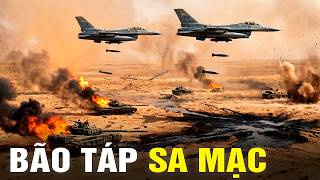
BÃO TÁP SA MẠC! Mỹ Đã Nghiền Nát Đội Quân IRAQ Chỉ Sau 100 Giờ Trên Bộ Ra Sao
TL;DR
The Gulf War saw a US-led coalition decisively defeat the Iraqi army in a rapid 100-hour ground campaign following a devastating air war, driven by Iraq's invasion of Kuwait and a complex web of geopolitical and economic factors.
Key insights
The Gulf War was a swift and decisive military campaign driven by a complex interplay of political, economic, and strategic factors.
- Iraq's invasion of Kuwait was primarily motivated by severe economic distress following the Iran-Iraq War and a dispute over oil production and debt.
- The international coalition, led by the US, was formed rapidly due to a shared interest in regional stability and preventing Iraqi dominance.
- The military strategy employed by the coalition, particularly the air campaign and the flanking ground maneuver, proved overwhelmingly effective against the Iraqi forces.
The military superiority of the coalition forces, especially in air power and technology, was a critical determinant of the war's outcome.
- The air campaign systematically degraded Iraqi command and control, air defenses, and logistical capabilities, paving the way for ground operations.
- Advanced weaponry and tactics, such as precision-guided munitions, stealth aircraft, and rapid armored maneuvers, gave the coalition a significant advantage.
- The Iraqi military, despite its size, suffered from outdated equipment, poor morale, and a lack of effective strategic planning against a technologically superior adversary.
The aftermath of the Gulf War had profound and lasting consequences for Iraq and the broader Middle East, extending far beyond the immediate conflict.
- The war's end did not lead to Saddam Hussein's downfall, leaving a destabilized Iraq vulnerable to internal uprisings and continued international sanctions.
- The suppression of post-war rebellions in Iraq resulted in significant civilian casualties and humanitarian crises, highlighting the complex geopolitical landscape.
- The conflict reshaped regional power dynamics and set the stage for decades of continued instability and intervention in the Middle East.
Key moments
- 00:00The video begins by setting the scene of Iraq's invasion of Kuwait on August 2, 1990, highlighting the swiftness of the Iraqi advance and the world's surprise.
- 01:26It details Iraq's dire economic situation post-Iran-Iraq War, with massive debt and reconstruction costs, exacerbated by falling oil prices and disputes with OPEC members like Kuwait and UAE.
- 03:02Saddam Hussein's attempts to resolve the economic crisis through diplomacy failed, leading him to consider military action against Kuwait to seize its oil wealth and cancel debts.
- 04:30Iraq amassed nearly 100,000 troops on the Kuwaiti border, a threat initially underestimated as mere political pressure, but it escalated to a full-scale invasion on August 2, 1990.
- 05:40The international response was swift: the UN imposed sanctions, Saudi Arabia allowed US troop deployment, and a broad coalition formed to liberate Kuwait and restore its government.
- 07:10The coalition rapidly grew to 42 nations, with key roles for the US, UK, France, Saudi Arabia, Egypt, and Kuwait, while Iraq fortified its defenses.
- 08:00Operation Desert Shield involved an unprecedented logistical buildup in Saudi Arabia, preparing over 157,000 US troops and allied forces for combat.
- 09:30Operation Desert Storm commenced on January 17, 1991, with a massive air campaign targeting Iraqi air defenses, command centers, and infrastructure.
- 11:10Iraq retaliated by launching Scud missiles at Israel and Saudi Arabia, attempting to break the coalition, but these efforts were largely ineffective.
- 12:30The air campaign intensified, destroying Iraqi military capabilities and causing widespread defections, culminating in the ground offensive.
- 14:10The 100-hour ground war began on February 24, 1991, with a massive coalition advance, including a large flanking maneuver to cut off Iraqi forces.
- 16:00The ground offensive rapidly overwhelmed Iraqi defenses, with allied forces breaching minefields and advancing deep into Kuwait and Iraq.
- 18:00Fierce tank battles occurred, showcasing the technological superiority of US armor, while oil fires created severe environmental damage.
- 19:30The Iraqi army collapsed, leading to chaotic retreats, famously depicted in the 'Highway of Death' incident, effectively ending organized resistance.
- 21:00Following the war, internal uprisings in Iraq were brutally suppressed by Saddam Hussein's regime, with limited intervention from the coalition due to geopolitical concerns.
- 23:00The war's conclusion left Kuwait liberated but Iraq weakened and unstable, with ongoing sanctions and the seeds of future conflicts sown.