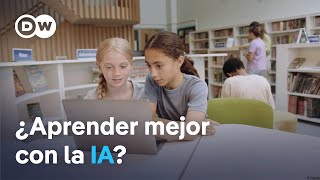
Cómo usar (bien) la IA en la escuela: riesgos, reglas y oportunidades
TL;DR
The video explores the integration of Artificial Intelligence in education, highlighting its potential for personalized learning and efficiency while addressing significant risks to critical thinking, creativity, and academic integrity, advocating for responsible use and pedagogical adaptation.
Key insights
AI integration in education presents a dual-edged sword, offering personalized learning and efficiency gains while posing risks to critical thinking and creativity.
- Students are widely using AI tools, prompting educators to find a balance between prohibition and unrestricted use.
- Specialized AI tools like ChatGPT Edu aim to support teachers and personalize learning, but concerns remain about data privacy and corporate influence.
- The core challenge lies in adapting educational methods to leverage AI as a tool for enhancement rather than a substitute for fundamental learning processes.
Effective AI integration requires a pedagogical shift and clear guidelines for both students and educators.
- Teachers are primarily using AI for lesson planning and administrative tasks, with less integration into direct instruction.
- Establishing clear rules, like the 'traffic light' system in the US, helps students understand acceptable AI use for feedback and idea generation versus prohibited uses like drafting or rewriting.
- Curricula need to evolve to teach AI literacy, critical evaluation of AI-generated content, and digital citizenship.
Global approaches to AI in education vary, from early primary integration in India to Estonia's structured implementation and the US's focus on preventing plagiarism.
- India is pioneering AI education from primary school, using AI tools for personalized learning and teacher support.
- Estonia is integrating ChatGPT Edu with pedagogical guidelines and data protection measures, viewing AI as a national curriculum component.
- US educators are developing strategies like in-class assignments and revised task design to mitigate AI-facilitated cheating and promote critical thinking.
Over-reliance on AI tools without understanding foundational concepts can hinder genuine learning and future employability.
- Students may use AI to bypass the learning process, impacting the development of critical thinking and problem-solving skills.
- The analogy of calculators highlights that while tools can accelerate tasks, understanding the underlying concepts remains crucial.
- Universities must adapt assignments to foster higher-order thinking skills that AI cannot easily replicate, ensuring students develop transferable abilities.
The dominance of private tech companies in educational AI raises concerns about pedagogical sovereignty and potential inequalities.
- Allowing private companies to heavily influence educational content and methods risks ceding control over pedagogical design.
- The 'black box' nature of many AI models makes it difficult to assess biases, errors, or their impact on students.
- Without robust regulation, the accelerated adoption of AI could exacerbate existing educational disparities and compromise fundamental rights.
Key moments
- 00:00Introduction to the rapid pace of AI in education, posing promises of easier learning but also concerns about creativity and critical thinking, setting the stage for the central question: how to learn effectively with AI.
- 01:40Introduction of ChatGPT Edu, a specialized version of OpenAI's chatbot for higher education, with Estonia's approach to implementation, focusing on pedagogical alignment and data protection.
- 04:59A German class in Estonia demonstrates the use of ChatGPT Edu for language learning, with students using it for tasks like writing and grammar correction, preparing them for future professions.
- 07:26Teachers are increasingly using AI for lesson planning and administrative tasks, with a focus on how AI can support learning without replacing fundamental cognitive processes, emphasizing the need for careful task design.
- 09:15An educator in the US shares strategies for integrating AI, using a 'traffic light' system to guide students on acceptable uses for feedback and idea generation, while prohibiting its use for drafting or rewriting.
- 11:49India's initiative to teach AI and computational thinking from primary school, utilizing AI tools like Crisalis to personalize learning and provide teachers with insights into student performance.
- 15:33The challenge of AI's impact on learning, with risks of academic dishonesty and homogenization of thought, emphasizing the need for teacher training to promote ethical and responsible AI use.
- 18:03Universities are adapting by changing assignment formats to focus on critical thinking and practical projects that AI cannot easily replicate, acknowledging that students will use AI and adjusting teaching methods accordingly.
- 20:51Concerns are raised about the dependency on large tech companies, the lack of transparency in AI models, and the potential for AI to widen inequalities and compromise pedagogical sovereignty.