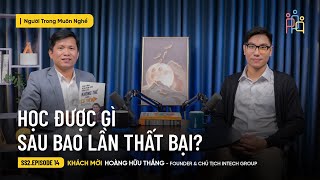
Dù Thất Bại Đau Đớn Thế Nào, Ta Vẫn Phải Đứng Lên | Hoàng Hữu Thắng | Chủ Tịch Intech | #NTMN EP 14
TL;DR
Hoàng Hữu Thắng shares his inspiring journey from a difficult rural childhood and multiple university failures to founding and leading Intech Group, emphasizing resilience, continuous learning, and strategic growth in the manufacturing sector.
Key insights
Resilience Forged Through Early Hardship
- Hoàng Hữu Thắng's childhood in a mountainous region involved significant labor from a young age, including farming and selling vegetables, which instilled a strong work ethic and ability to endure hardship.
- Experiencing poverty and the unpredictability of agricultural income fueled a deep-seated desire to escape hardship and pursue a better life through education and career advancement.
- These early struggles were not seen as mere suffering but as crucial training that built mental fortitude and resilience, enabling him to overcome later challenges in business and life.
The Perils of Stubbornness in Pursuing Goals
- Thắng failed university entrance exams five times, a journey marked by persistence but also a degree of stubbornness, particularly in his unwavering focus on specific prestigious universities.
- He acknowledges that while persistence is valuable, excessive stubbornness can lead to wasted time and missed opportunities, advising others to be adaptable and re-evaluate goals after repeated setbacks.
- The experience taught him the importance of self-reflection, identifying when a goal or approach is no longer suitable, and the need to pivot rather than blindly persist.
Building a Business from Scratch with Limited Resources
- Intech was founded with virtually no capital, experience, connections, or clients, starting from a rented room.
- Initial growth was driven by relentless effort, seeking small orders, and outsourcing manufacturing while focusing on assembly and customer service.
- The company's expansion was strategic, reinvesting profits into acquiring machinery and expanding capabilities incrementally, rather than taking on excessive debt or risk early on.
Continuous Learning and Leadership Growth
- Thắng emphasizes that a leader's growth directly impacts the company's growth; if the leader doesn't evolve, the business stagnates.
- He actively sought knowledge in areas where he lacked expertise, including business, marketing, management, and finance, through self-study and continuous learning.
- As the company grew, he learned to delegate, build a strong team, and focus on strategic, high-level management rather than getting bogged down in operational details.
The Strategic Importance of Manufacturing and Automation
- The mechanical engineering and automation sectors are identified as crucial for national industrial development and economic strength.
- These fields offer significant potential and opportunities, especially with global supply chain shifts favoring countries like Vietnam.
- While challenging and requiring substantial investment, these industries are vital for a nation's self-sufficiency and global competitiveness.
Key moments
- 00:00:00Introduction and guest introduction.
- 00:01:40Hoàng Hữu Thắng introduces Intech Group, its founding 12 years ago from a rented room, and its expansion into mechanical engineering, automation, technology, and energy.
- 00:02:52Thắng reflects on his childhood hardships and early struggles in Hanoi, which forged his resilience and determination for entrepreneurship.
- 00:05:11Discussion shifts to Thắng's childhood in Lục Nam, Bắc Giang, detailing his family background and early responsibilities.
- 00:06:48He describes his childhood chores, including farming and selling vegetables, highlighting the physical labor and early exposure to hardship.
- 00:10:09Thắng reflects on how these early challenges cultivated his resilience and ability to overcome future difficulties.
- 00:11:42The conversation touches on the value of early difficult experiences in shaping character and strength.
- 00:12:10Thắng discusses his motivation to pursue a different path than farming due to its unpredictability and hardship.
- 00:13:09He explains his desire to escape poverty and the limitations of rural life, driven by parental expectations and a yearning for a better future.
- 00:17:35Thắng recounts his decision to pursue higher education as a means to escape his circumstances.
- 00:21:24The narrative focuses on Thắng's five attempts to pass university entrance exams and his persistence.
- 00:23:14He details his initial attempts to study teaching and then his shift towards engineering, facing repeated failures.
- 00:26:32Thắng describes dropping out of a college program to focus solely on university entrance exams, a decision he later views as potentially stubborn.
- 00:28:34He shares the immense emotional toll of failing multiple times, including periods of deep distress and self-doubt.
- 00:30:30Thắng explains his final attempt, shifting focus to Economics and National Economy University, while working various jobs.
- 00:33:01He describes the profound disappointment of failing even after intense effort and the feeling of being stuck.
- 00:36:19Thắng eventually enrolls in Hanoi University of Industry, finding success and engagement through student activities.
- 00:38:11He reflects on the lessons learned from the five failures, acknowledging both the pain and the valuable character development.
- 00:40:11Thắng admits he wouldn't repeat the five-time failure, viewing it as a mistake stemming from stubbornness, but values the lessons learned.
- 00:42:06He advises listeners to be aware of the 'stubbornness trap' in pursuing goals, whether academic or entrepreneurial.
- 00:45:12Thắng discusses dealing with peer pressure and the feeling of being left behind as friends graduated and started careers.
- 00:47:38He recounts how many peers gave up due to age and pressure, but he persevered, balancing studies with work and extracurriculars.
- 00:50:28Thắng transitions to his entrepreneurial journey, starting Intech after working for two years in the helmet industry.
- 00:51:33He explains his decision to leave the helmet business due to its limited future prospects and pivot to mechanical engineering.
- 00:53:13He details the challenges of starting Intech with no capital, experience, or connections, operating from a rented room.
- 00:55:46Thắng recounts a harrowing experience with his first order, involving a dispute over payment and a near-fatal accident.
- 00:59:02Despite early setbacks, he continued to build the business, gradually securing more clients and improving financial stability.
- 01:00:21He describes the intense work schedule in the early days, working 16-20 hours a day, and the physical toll it took.
- 01:02:04Thắng emphasizes the importance of continuous learning for leaders, as the company's growth is tied to the leader's development.
- 01:03:18He details his self-driven learning process, acquiring knowledge in business, marketing, management, and finance as needed.
- 01:05:34The leader's vision and growth are critical; if the leader's level doesn't rise, the company cannot advance.
- 01:07:07He stresses the need for leaders to constantly learn and adapt to keep pace with their growing businesses.
- 01:07:39Thắng discusses the potential and importance of the mechanical engineering and automation sectors, despite their perceived 'dryness'.
- 01:09:39He highlights how strong manufacturing and industrial sectors are key to a nation's wealth and global competitiveness.
- 01:11:35The industrial support sector, including mechanics and automation, offers vast employment opportunities but requires careful consideration for startups due to high investment needs.
- 01:13:29He notes the current opportunities in Vietnam due to global supply chain shifts and foreign investment interest.
- 01:16:07Thắng explains his early investment strategy: focusing on design and outsourcing manufacturing, then assembly, before investing in machinery.
- 01:17:58He describes the gradual investment in machinery, starting with used equipment and progressively upgrading as resources allowed.
- 01:20:27He emphasizes the importance of financial prudence, avoiding over-investment in machinery and maintaining liquidity.
- 01:22:35Thắng advocates for reinvesting profits into the core business rather than diversifying into unrelated assets like real estate.
- 01:25:15He discusses time management, explaining how delegation and focusing on high-impact tasks allow for work-life balance.
- 01:28:13Effective time management involves focused work, delegation, and prioritizing tasks to create space for family and personal development.
- 01:29:25Thắng mentions his recently published book, 'Turning the Seemingly Impossible into the Possible'.
- 01:33:12His final advice is to remain persistent and patient in pursuing dreams, believing that anyone can achieve what they set their mind to.